
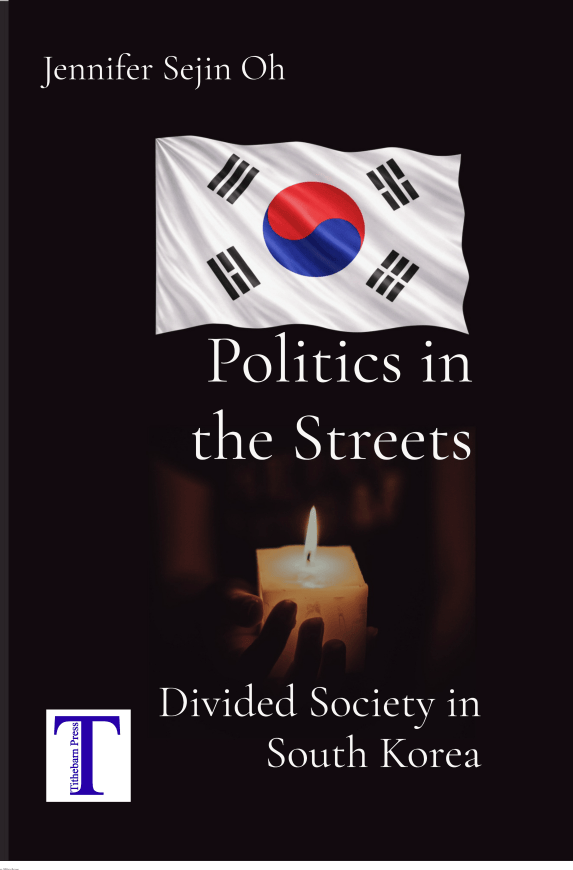
We’re thrilled to announce that our third title will be Politics in the Streets: Divided Society in South Korea by Jennifer Sejin Oh of Ewha Womans University.
Another addition under our Power theme, this book examines a common axiom of political science — that a strong civil society is an asset for a democratic society — and whether events in South Korea over the past decade call this into question.
Many of us will have at least a passing familiarity with the dramatic political events in Seoul in early 2024, when President Yoon declared martial law, only to be promptly overruled by the National Assembly. With remarkable speed he was defenestrated, impeached and subsequently imprisoned for attempting to overthrow democracy. The rapid and overwhelming response by both the political class (including several elected members of Yoon’s own party) and civil protests was noted by many as being in very positive contrast to the near contemporary efforts to whitewash the January 6th attempted insurrection in Washington DC, once Donald Trump won his second election in 2024. The mobilization of large numbers of ordinary South Koreans in protest made it much harder for the armed forces to follow their unconstitutional instructions from the president, and emboldened South Korea’s lawmakers to fight their way into the Assembly to overrule Yoon. It is tempting to see this as a parable of how a strong democracy can stand up against authoritarian manoeuvres, but as so often the reality is more complicated and less comfortable.
As Jennifer argues in this book, South Korean politics has come to be dominated by mobilizations of protesters on the streets, and crucially by two rival blocs of such protesters. These two blocs align closely with the comparatively weak progressive and conservative parties respectively. Indeed, the history of schisms and subsequent rebrandings of the political parties (such that I can only succinctly refer to them here in broad ideological terms) on both sides of the political divide illustrates this relative weakness. While either bloc can mobilize significant numbers of protesters out on the streets of Seoul, they do not have a coherent or sophisticated means for effecting policy outcomes beyond what can be shouted through a megaphone. In the absence of mediating political infrastructure much is driven by numbers of feet on the ground, marching to the loudest voices and simplest slogans.
I won’t rehearse the entire argument here, you need to read the book for that, but suffice to say that in tracing the history of civic protest in South Korean political life since the dictatorship of Park Chung-hee, Jennifer shows how the same elements that have contributed to strengthening liberal democracy are now in danger of undermining it. This is a gripping story about South Korea, a country whose ostensibly strong democracy has relatively shallow roots, but it is also a vital case study for our understanding of the impact of negative polarization and ossified partisanship on democratic vitality. It speaks to the challenge of maintaining democratic institutions in countries where a sizeable minority of the population will stand up for their own political tribe, regardless of their objectively clear malfeasance. It’s a story that will be familiar to those of us in Britain who lived through the Brexit, Boris and Truss eras, to Americans still aghast at the die-hards of the MAGA movement, or French readers living through their latest iteration of negatively-polarised street politics.
But don’t just take my word for it, here’s what Antonio Fiori, President of the Asia Institute and Associate Professor of the History and Institutions of Asia at the University of Bologna, had to say:
“A vibrant civil society is no guarantee of a healthy democracy. Jennifer Oh explores this unsettling proposition through a perceptive account of South Korea’s changing protest politics. This timely book challenges comfortable assumptions about civic participation and offers lessons that resonate well beyond the Korean peninsula.”
Politics in the Streets will be available to order in Papaerback and ebook from the 9th of December. We’ll be posting more about it, including a sample chapter, in the coming weeks, so watch this space!
