
Last week we looked at the publishing process from 10,000 metres, before talking about how we get a project started. Continuing with our example of Sarah Connor and her magnum opus Resisting the Rise of the Machines: Will Skynet “be back”? this week we will be going through the Production process step by step. I should say that the details of this may vary a bit from publisher to publisher. Many large presses will outsource most of this work, whereas we currently do it in house, which has some advantages.
Nevertheless while details (and especially timing) may vary, the broad picture remains much the same. Some publishers won’t design a cover — instead using a standard corporate design, others won’t check proofs — leaving it up to just the author. Copy-editing to some degree is still near-universal, although there is quite a bit of variation by degree. Who is responsible for preparing an index varies considerably. Actual copies printed, in what formats and locations will vary somewhat too, although this may actually be surprisingly more convergent than in the past, as print and distribution economics change.
Production, in detail
In many respects this is the part of the process that people traditionally tend to think of when they think about “publishing”. It is also the largest single (depending on the marketing budget) investment of time and resources that a publisher makes in a book. At the same time, it’s actually a relatively small portion of the overall process. It takes a few weeks or months, whereas origination usually takes many times longer, and ongoing support of a published title is theoretically indefinite – likely to run to years, if not decades.
I have already written a little about what we do once we have a manuscript in house, so I’ll try not to repeat myself here. In essence there are a series of stages we need to go through in order to translate Sarah’s raw manuscript into a “proper” book.
Editing
In all likelihood we will have been giving Sarah feedback on the substance of her manuscript as she was writing. Once we have the whole thing we’ll read it through and give her feedback based on the whole manuscript. This might be quite minimal if we saw a lot as she went along, but some authors do prefer to write largely on their own and then have most of our feedback all at once.
With the content of the manuscript settled, we move on to copy-editing. This is where we focus on more basic things like spelling, punctuation and grammar. If need be we might also tackle more macro level issues like paragraph and sentence structure, but with an emphasis on style and clarity rather than substance at this point.
Backend
There are a couple of other things we get in place once we have the manuscript in house. These are small details but important to the success of Sarah’s book.
We allocate an ISBN for each version of the book that we intend to publish. For those not aware, an ISBN is an internationally standardised 13-digit number allocated to each version of each book that is published. A version could be a hardback, a paperback, or an ebook, and each version requires a different number. For most of our books we publish all three versions, though for Sarah’s book perhaps an ebook won’t be such a good idea. When we allocate an ISBN to a book we register this with Nielsen, the agency that keeps a track of all the books published around the world.
We also need to register every book we publish with the British Library, who then provide us with cataloguing data that helps ensure Sarah’s book can be found through library systems worldwide. Later we’ll also be required to supply a single copy of Sarah’s books to the UK’s copyright libraries in London, Oxford and Cambridge. This is a legal requirement for publishing in the UK (there is a similar arrangement with the US Library of Congress for US-based publishers).
Lastly we add Sarah’s book to our account at the Copyright Licensing Agency. This permits them to manage the licensing for small scale rights usage, such as photocopying for educational purposes, on our and Sarah’s behalf. This includes managing the receipt of any fees that are due for this legitimate usage, which they the distribute to us and to Sarah accordingly.
Typesetting
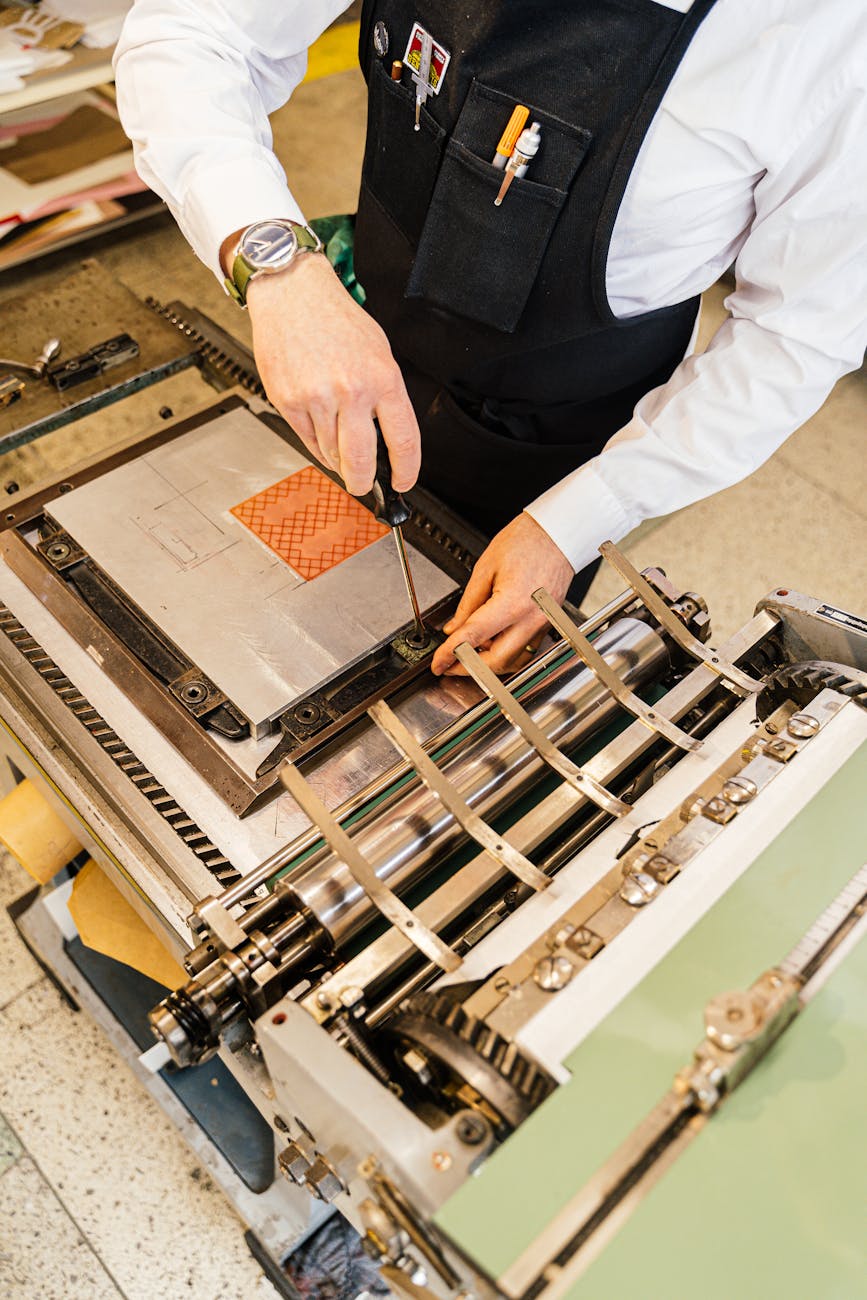
This is a rather grand term that harks back to the early days of movable type, when a “Typesetter” was a person who would quite literally set the type into place on physical plates that would then be inked and pressed onto paper to produce the book pages. These days we have software that takes care of the mechanics of this for us, so it’s just a question of laying out our text and images on screen as we want them to appear in the final book.
Laying out a book is one of those processes where the bulk of the task is simple and requires comparatively little effort, and most of our time is spent ironing out small wrinkles. These are likely to be things like making sure images are in the right place, and are cropped and sized appropriately (see here for more details about images and the issues they generate). Other wrinkles might derive from things like needing to delink endnotes (typesetting software tends to hate footnotes entirely), keeping a-heads, b-heads and other formatting consistent throughout, and oddities that are introduced by the interaction of the software’s design template with MS Word’s formatting. Thus, it can often be 80-95% complete very rapidly, but then take a few hours to get to 100%.
Proofs
Proofs (or Galley Proofs) is the industry term for the initial output of the typesetting process. We’ll send digital copies of these laid out pages to Sarah and ask her to check that they look right and that we haven’t inadvertently introduced any errors. As we’re quite flexible, we will also allow her to make minor changes at this stage, although many publishers won’t unless the changes are very important, or else may deduct a penalty from her royalties to cover the cost. One of the benefits of being small, nimble, and largely self-sufficient is that we can deal with small things like this more easily. Just as well if there’s a T1000 bearing down on you while you’re trying to make sure you’ve used your apostrophes and not you’re apostrophe’s.
Once the proofs have been checked, and any corrections marked up, then we’ll “be back” (I had to get that in somewhere) to completing the typeset files, and can finalise the pagination. That is to say, we now lock down the text, so that we know with confidence what will be on which page and thus have our final page numbers. That allows us to move onto…
Indexing
I’ve written about this (and alluded to several of the other stages we’ve just looked at) previously. Suffice to say that once the pagination is final, we’re ready to take our list of key terms and index them, so that print readers in particular can easily locate them in the text. Or look up their own name to see how many times they’re referred to throughout the book.
Cover Design
I briefly touched on some issues relating to cover design in the third part of my epic series on Images, here and I will no doubt delve into it in greater depth in a future update. There actually is no fixed point in the publishing process for designing the cover. It clearly needs to be done before the book can be published, but it’s often smart to settle it even before the manuscript is finished.
There are two main reasons for this. The first is the obvious logistical one — these things can take time and it’s not ideal to have to rush them at the end, while we’re also busy with all of the parts of the production process that do have to be done in sequence. Notably, it can be a good way for us to be doing something useful while Sarah is busy writing (and, presumably, blowing up Cyberdyne), we’ll need her input, but once we’ve agreed on some images to work with, a lot of the legwork is on our end.
The second reason is more psychological. It can be really helpful for all concerned to be able to picture the book. It makes it seem that much more real, which will motivate Sarah to keep up the writing, while enabling us to begin public-facing communications and promotions for the book whenever it’s opportune.
Publish
Once everything — including the cover and index — is final, we close up the files and hit the publish button. Some cogs have to whir on the back end for a few days, and then the book will go live. Notwithstanding Sarah’s probable wariness around digital copies, the ebooks will then be available to download from online bookstores (I’m sure you can think of one or two), and the print edition will be live to order on a print-on-demand basis. At that point we’ll stock up a few copies in-house, as well as sending Sarah the author copies to which she will be entitled. The books are now available to be bought and read, which just leaves the small matter of telling everyone about them. Come back next week for that part of the process…
If you’d like to discuss a book project with us, please do drop us a line on proposals@tbarnpress.com.

Comments
3 responses to “A Walkthrough of the Publishing Process: Part Two – Production”
[…] the past two weeks, we’ve looked at how book projects begin and how manuscripts are transformed into books via the production process. This week we’ll continue by looking at what happens after a book is published. As before […]
LikeLike
[…] to say a little about what I’m up to. Think of it as a kind of realtime version of my three part walkthrough of the publishing […]
LikeLike
[…] should be doing much of the running, there’s been less call to write about this. However, the second part of my series on the complete process covers this period in soem detail, and there are other pieces that also refer mainly to this […]
LikeLike